
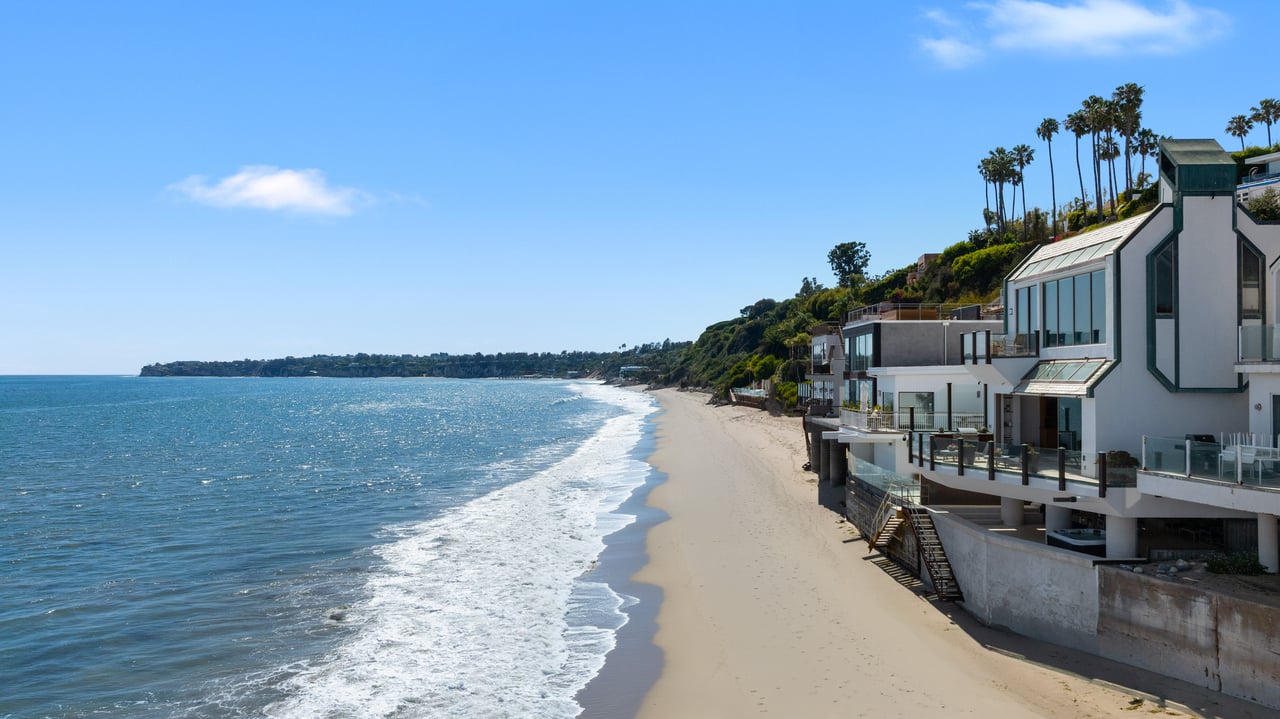
A buyer touring a listing on Escondido Beach Road this fall will likely see the same thing every visitor before them has seen: a weathered staircase down to the sand, a deck cantilevered a few feet above the tideline, and somewhere near the property line, a hand-lettered sign that says "Private Beach." What that buyer will not see, unless someone tells them to look, is the recorded document sitting in the title chain that may say otherwise.
Escondido Beach has spent forty years as one of Malibu's most contested strips of sand, not because the water is different from the water at Point Dume or Broad Beach, but because of what individual homeowners agreed to trade for the right to build. That history did not end when the last fence came down. It is still sitting in county records, parcel by parcel, and it matters more to a serious buyer here than square footage or view corridor ever will.
The Deal That Built the Neighborhood
California's Coastal Act has long required that any new construction along the shoreline preserve public access to the beach. On Escondido Beach, one of the tools the California Coastal Commission used to enforce that requirement was the Offer to Dedicate, a condition attached to a coastal development permit that requires a landowner to grant a public access easement across their property in exchange for approval to build. The Commission has attached more than 2,000 of these offers to permits along the California coast, and Escondido Beach carries some of the more visible ones.
A 2025 investigation in Places Journal traced how this played out here specifically. Owners along this stretch have granted lateral access across their dry sand in return for approval to add a deck or a bedroom that the Coastal Act would not otherwise allow. Because each grant was struck separately, at a different time, for a different addition, the resulting map of who owes the public what does not follow a clean, uniform pattern from one lot to the next.
That is the mechanism a buyer needs to understand before falling for the view. Two homes can sit side by side on Escondido Beach Road with nearly identical footprints and asking prices, and carry entirely different obligations to the public, because one owner traded access rights for a past remodel and the neighbor never did.
Forty Years, Two Fences, One Path
The clearest evidence of how this system can stall is the enforcement case that closed in 2023, and it involves two named properties most buyers will recognize once they hear the addresses.
The Coastal Commission first required a trail easement here in 1978 and a second easement for a parking lot in 1981. Neither obligation was fulfilled. In 2014, the Commission gained authority to levy administrative fines against Coastal Act violators, and its enforcement staff reopened the Escondido Beach file. Notice of Violation letters went out in 2017 to Don Wildman, the late founder of Bally Total Fitness, and to Frank Mancuso, the former Paramount Pictures and Metro-Goldwyn-Mayer executive. Wildman died in 2018, and the obligation passed to his family trust.
In June 2023, the Commission voted unanimously to enforce construction of a beach access trail and small public parking lot across parts of two adjacent properties, one owned by the Donahue L. Wildman Family Trust at 27910 and 27856 Pacific Coast Highway, the other by the Mancuso Family Revocable Trust at 27920 Pacific Coast Highway. Mancuso was required to demolish an unpermitted driveway and pay a $600,000 fine. The Wildman family trust took on the larger task: building the new accessway, installing five public parking spaces, adding a restroom, and posting Commission signage along PCH. Lisa Haage, the Commission's chief of enforcement, put the rarity of the outcome plainly, telling reporters that new vertical accessways are like unicorns in Malibu.
Year | What happened |
|---|---|
1978 | Coastal permit first requires a trail easement across the property |
1981 | Commission requests a second easement, for a parking lot |
2014 | Commission gains authority to levy administrative fines for Coastal Act violations |
2017 | Notice of Violation letters sent to the Wildman and Mancuso families |
2018 | Don Wildman passes away; obligation passes to his family trust |
June 2023 | Commission votes to enforce construction of accessway and parking lot |
2024 to 2025 | New public path, five parking spaces, restroom, and signage completed across the Wildman parcels |
The total value of the resolution, counting construction costs and penalties, ran over $4 million. That is not a rounding error on a real estate transaction. It is the kind of number that shows up as a lien, a condition, or a disclosure item on the specific parcels involved, and it took forty years and a change in enforcement law to resolve.
What Closed in 2023 Didn't Close the Question
The new accessway across the former Wildman and Mancuso parcels, along with its five parking spaces and restroom, gives the public a second formal entry to Escondido Beach beyond the long-standing routes through Geoffrey's Restaurant and the gate at 27148 PCH. For a buyer evaluating a specific home, proximity to that new access point cuts two ways. It resolves decades of legal uncertainty for the two parcels directly involved. It also means any home near that stretch now sits closer to a public parking area and a marked public path than it did before the settlement, which is worth weighing against whatever privacy assumptions a buyer walked in with.
Meanwhile, the older access points remain what they have always been. The gate near 27148 PCH still has limited free parking, and the stairway near Geoffrey's still routes foot traffic past a working restaurant. None of that changed in the 2023 settlement. What changed is that one more piece of the beach's access puzzle is now built, recorded, and public, while the rest of the shoreline's access history remains parcel-specific and, in some cases, still informal.
Reading a Title Report Like a Former Attorney Would
None of this shows up on a listing sheet, and very little of it shows up in a standard walk-through. It shows up in the preliminary title report, the coastal development permit history, and the Commission's own enforcement files. Before writing an offer on Escondido Beach, a buyer's team should be doing the following:
- Pull the preliminary title report and read every recorded easement, not just the ones flagged as exceptions to insurable title.
- Check the parcel's coastal development permit history for any Offer to Dedicate tied to a past remodel or addition.
- Confirm whether any lateral access grant on the parcel is recorded and enforceable, or merely offered and never perfected.
- Ask how close the specific parcel sits to the new PCH accessway and parking area built across the former Wildman and Mancuso parcels, and what that means for morning foot traffic past the property.
- If short-term rental income is part of the plan, factor easement status into the disclosure conversation alongside the city's permit and transient occupancy tax requirements for rentals here, since summer rates on this stretch have reportedly run as high as $90,000 a month in peak season.
This is not paperwork for its own sake. It is the difference between buying a beach house and buying a beach house with an unresolved forty-year-old obligation attached to it. A real estate attorney reads a coastal title file differently than a general practice agent does, because the easement language on a Malibu beachfront parcel rarely reads like a standard suburban lot line. It reads like a negotiated settlement, because in a real sense, it often was one.
The Number That Doesn't Move With the Easement
Here is the part that surprises buyers who assume legal complexity means a discount. It does not. Core beachfront listings on Escondido Beach have generally sat in the $8 million to $20 million band, and two 2025 closings anchor that range on the high end: a home at 27218 Pacific Coast Highway sold for $17,600,000 in October 2025, and a home at 27368 Escondido Beach Road closed the same month for $11,650,000. Both were renovated, move-in ready properties, and neither sale hinged on the buyer's awareness of the parcel's access history.
That is the point. Price here tracks frontage, renovation quality, and view corridor. Access history tracks a completely separate and older set of decisions made by a completely different set of owners. A buyer who treats the two as connected, assuming a clean title report because a home is priced at the top of the market, is making an assumption the record does not support.
A Few Direct Questions
Does a recorded easement lower what a home is worth? Not necessarily. The two 2025 sales above closed at the high end of the neighborhood's range regardless of each parcel's specific access history. Easement status affects use and disclosure, not automatically price.
Does every home on Escondido Beach carry one of these easements? No. The practice varied by owner and by decade, which is exactly why the property lines look inconsistent from above. Some parcels have recorded lateral access grants tied to past permits. Others do not.
How would I actually find out before making an offer? Through the preliminary title report and the parcel's coastal development permit file, not through a listing description or a walk-through. This is precisely the kind of document review worth doing before, not after, an offer is accepted.
Escondido Beach rewards buyers who ask the second question after the view, not instead of it. If you are evaluating a specific property here and want someone who reads the title history the way a real estate attorney would before you're in escrow, MalibuMark is a good place to start that conversation. Let's schedule an appointment.