
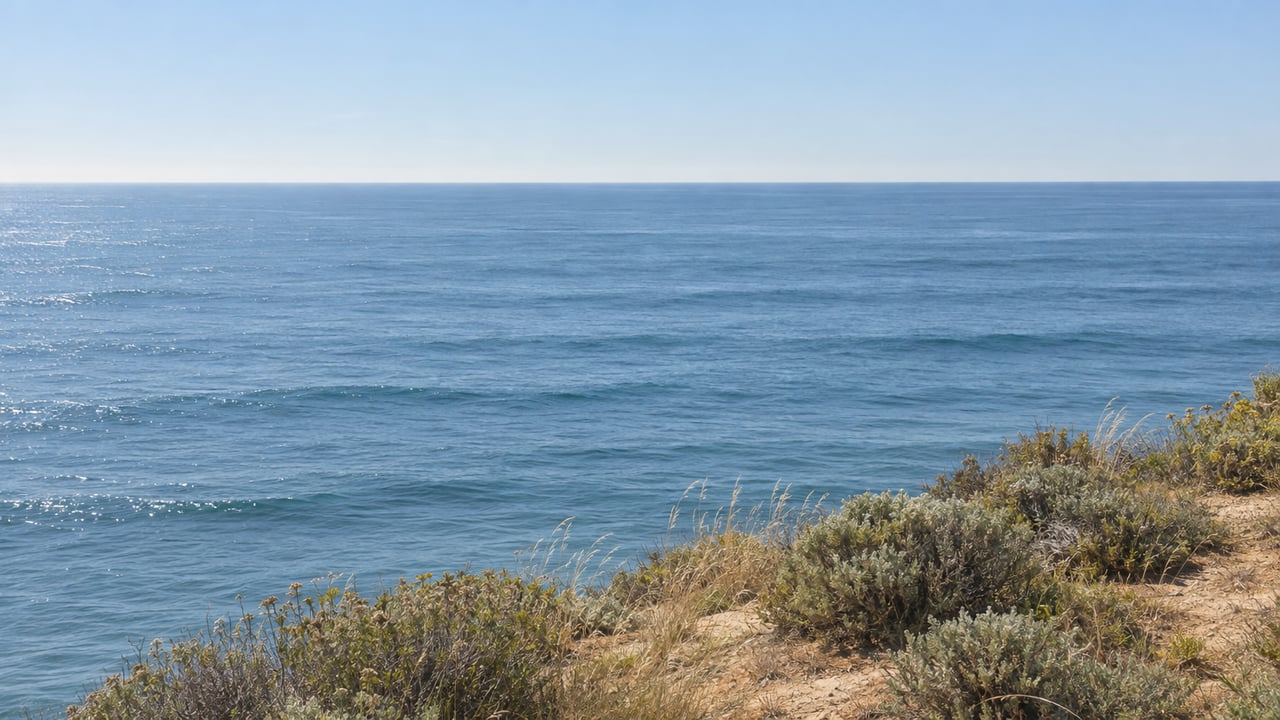
On Sunday, February 1, 2026, the air off Point Dume was 73 degrees and the water was flat and glassy. About an hour before sunset, three southbound gray whales passed roughly a mile and a half offshore, and the late sun lit up their heart-shaped blows. It was logged as "Day 1" on Spyhop Lane, the blog of a Point Dume whale counter named Alison.
California State Parks gives Point Dume's whale window as December to mid-April. The count kept from the headland points later. On this stretch of coast, the strongest whale days have come in February, March and early April, when the grays head back north. This winter there's a second change. Westward Beach Road is under repair, so the reliable way onto the headland starts from the small lot at the top of Cliffside Drive.
The Count Kept From the Point
There is no official whale census at Point Dume. The American Cetacean Society's Los Angeles chapter runs its season-long gray whale census from the Point Vicente Interpretive Center on the Palos Verdes Peninsula. Volunteers there watch in daylight from December 1 through late May.
Point Dume's record comes from one person. According to the Spyhop Lane About page, Michael Smith of the Gray Whale Count in Goleta encouraged Alison to "unofficially" count whales at Pt Dume in 2013, "where an official census does not take place." She photographs the whales passing the Point Dume State Marine Reserve so individual animals can be identified by their markings. The blog takes its name from a habit she saw early on. The whales spyhop in consistent places along the coast, and they hold to particular paths "similar to cars on a freeway." She writes that the part of Point Dume where she counts is one of those lanes.
Her daily entries open with a tally of northbound whales, southbound whales and hours watched. Across a season, those entries show when the point is busy.
The Northbound Leg Is the Bigger Show
The Point Vicente census, down the coast on the Palos Verdes Peninsula, shows the same pattern in larger numbers. In the 2024–25 season, which ran December 1, 2024 to May 25, 2025, ACS-LA volunteers counted 130 southbound gray whales with no calves and 485 northbound whales with 8 calves. The 2023–24 season had the same imbalance at higher numbers: 225 southbound and 579 northbound. In both seasons, the spring return to Alaska made up most of the whales counted.
The Point Dume log fits that pattern. On February 14, 2026, Alison logged 16 northbound gray whales in nine sightings over 9.5 hours and none heading south. She called it "an unexpected surprise and welcome sight knowing the whales were late heading south this year." The year before, the first mother-and-calf pair of the season passed Point Dume on April 3, 2025. That day's log shows 9 northbound adults and 2 calves over 10.5 hours of watching.
Boat logs farther south match. Dana Wharf in Dana Point records the most gray whale days in February and March and puts the usual window at roughly December through April. December mornings on the bluff are still worth a look. Expect the sightings to pick up as winter turns to spring.
Reading This Year's Population Number
In July, NOAA Fisheries released a much higher estimate. Its Southwest Fisheries Science Center put the Eastern North Pacific gray whale population at about 17,750 whales, based on a count of whales migrating south, with a range of 15,930 to 20,530. The prior year's estimate was about 12,890, one of the lowest since counting began in the late 1960s. In its July 15, 2026 announcement, NOAA said "the reasons for the apparent increase remain an open question." Researchers are reexamining the whales' migratory timing and the behavioral assumptions built into the estimate.
The other numbers in that release don't point to a recovery. NOAA reported that many gray whales stranded along the West Coast in spring 2026 before reaching their Arctic feeding grounds, and that some were skinny or emaciated. NOAA's most recent calf estimate is 85 calves in 2025, the lowest in its series. The Point Dume log shows the same thing at close range. Some of the 16 whales on February 14 were underweight, with dips behind the head showing lost blubber. On April 3, 2025, what first looked like a second mother and calf turned out to be a single thin whale with its ribs showing along the spine.
The April 3, 2025 pair is the most recent local marker for calves off Point Dume, so a calf watch belongs in the late-season northbound weeks.
Getting Up the Headland During the Road Repairs
The State Parks trail into Point Dume Natural Preserve begins at the cul-de-sac at the end of Westward Beach Road. That cul-de-sac is inside the stretch that has been closed to cars since summer. According to the City of Malibu's November 10 notice, the access road at the end of Westward Beach Road remains closed to all vehicles. Pedestrians and cyclists may use it except during active construction. Westward Beach Road, Birdview Avenue and the beach itself remain open. The current phase is repairing 325 feet of existing rock revetment and was scheduled through November 25. The city's schedule shows no work November 26 to 29 over Thanksgiving weekend.
The County's Point Dume Beach page says construction generally runs from 5 a.m. to 3 p.m. and that pedestrians and cyclists may not enter active work areas. Restrooms 1, 2 and 3 are closed because of damage to the water service, and temporary toilets and handwashing stations are on site. In its November 10 update, the County said plans for the roadway repair are still being developed. State Parks has posted that the lower parking lot is unavailable while Westward Beach Road is closed, though the beach remains accessible.
That makes Cliffside Drive the more practical entrance this winter. State Parks lists free two-hour parking at the top of Point Dume, with day-use hours from sunrise to sunset. Hikespeak counts 10 spaces on Cliffside Drive, 2 of them ADA, and notes that parking is not allowed outside those spaces on Cliffside Drive or Birdview Avenue. For a Point Dume household within walking distance, the lot matters less than the time of day.
Once on the headland, the trail reaches a four-way junction with two ways to watch. The middle path climbs 70 feet in a tenth of a mile to the summit overlook, where a memorial plaque explains how a British sea captain named the point. From there the view runs west over Westward Beach and Zuma Beach toward Point Mugu. The other path is a level boardwalk that ends after an eighth of a mile at a viewing platform. Hikespeak calls the platform a good place to spot whales in spring. Dogs are not allowed in the preserve, and visitors are asked to stay on the trail to protect the ancient coastal bluff dune.
Timing a Morning or an Evening on the Bluff
The Point Dume log shows a few patterns. Alison's February 1 whales came an hour before sunset, a mile and a half out, so binoculars help on the southbound leg. The two-hour limit at the Cliffside lot covers a small share of a counting day. Her February 14 count took 9.5 hours to reach 16 whales, which works out to fewer than two whales an hour on one of the stronger days of the season. For a short visit, late February or March lines up with the busiest stretch in the Dana Wharf log. For calves, plan for April.
Thanksgiving weekend, with no construction scheduled from November 26 to 29, is a quiet time to check the route before the season builds. You can walk the boardwalk, find the platform, and see how the Cliffside spaces fill on a holiday afternoon. For coffee or dinner after, the Heathercliff corner and the rest of Point Dume are a short drive away. For background on how the lower lot came to close in August, see our earlier Westward Beach Road update.
At Mark Gruskin, we pay attention to the details of Point Dume, from the reopening of a beach road to the bluff-top spots with the clearest view of the spring migration. If you're weighing a home where the whales pass within view of the terrace, let's schedule an appointment and talk through the bluff together.